

When homeowners replace a driveway, they usually want more than a clean new surface. They want to know it will hold up.
In Michigan, that matters even more. Freeze-thaw cycles, moisture, seasonal loading, and shifting subgrade can all shorten the life of a driveway if the work underneath is not done correctly.
That is exactly why this project matters.
In this driveway replacement case study, Kent Home Services replaced an existing residential driveway that had already started to show early signs of failure. Five years later, the new concrete driveway remains crack-free, structurally sound, and performing as intended.
The Homeowner’s Challenge
The original driveway showed signs that it was not going to hold up long-term. Instead of simply pouring new concrete with the same issues, we approached the project by identifying what likely caused the earlier failure.
During the initial site evaluation, we looked at:
- existing cracking and settlement patterns
- soil conditions and drainage behavior
- garage approach and turning load points
- water runoff paths and low elevations
- frost-susceptible subgrade conditions common in Michigan
This step gave us the information we needed to design the replacement around the actual failure points, not just the visible surface problems.
Why the Original Driveway Was Failing
Concrete driveways do not usually crack for just one reason. In many cases, problems start below the slab. Poor drainage, unstable fill, weak base material, and movement from frost can all put stress on the concrete over time.
In this project, the existing sub-base showed signs of contamination and inconsistent compaction. Those are common causes of premature cracking and settlement. Leaving that material in place would have increased the risk of the new driveway developing the same problems.
Our Approach: Build the New Driveway for Long-Term Performance
The goal of this project was not simply to replace a damaged driveway. It was to build a concrete driveway system that could better handle Michigan conditions over time.
That meant focusing on the parts of the project that have the biggest impact on long-term performance:
- site evaluation
- full removal of compromised material
- proper base installation
- controlled compaction
- reinforcement in the right places
- water resistance and freeze-thaw protection
- intentional joint layout for movement control
Step 1: Full Removal of the Existing Concrete and Unstable Base
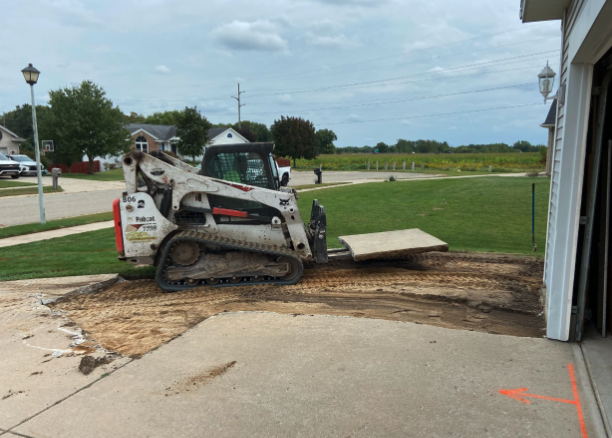
We removed the existing concrete and underlying sub-base where needed so the new slab would not rely on unstable material.
This mattered because a failing base often transfers its problems directly into new concrete. If the support underneath is inconsistent, the slab above it is much more likely to crack, settle, or shift. Full removal gave us a clean starting point for the replacement.
Step 2: Installing a Proper Base for Strength and Drainage
A strong driveway starts with a properly designed base. For this project, the base was installed to support the slab and help manage moisture.
The base strategy included:
- crushed aggregate in primary load areas for strength and interlock
- sand or fine material in select edges, transitions, and utility areas for uniform grade and slab thickness
- base depth adjustments based on soil conditions and expected load
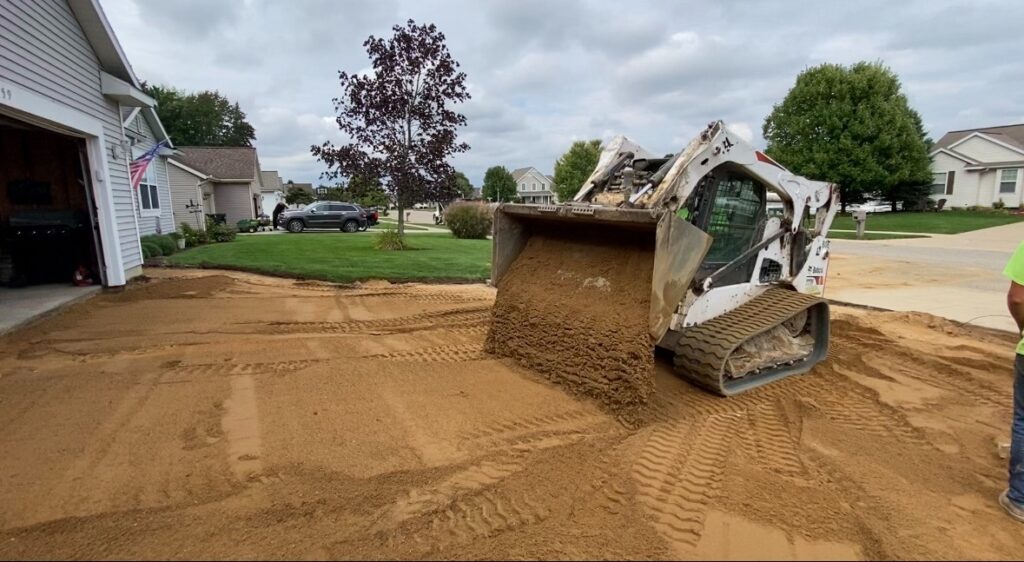
This layered approach created a more stable, well-draining foundation designed to handle freeze-thaw movement more effectively.
Step 3: Compaction Done in Controlled Lifts
Base materials were installed in controlled lifts and mechanically compacted across the driveway footprint.
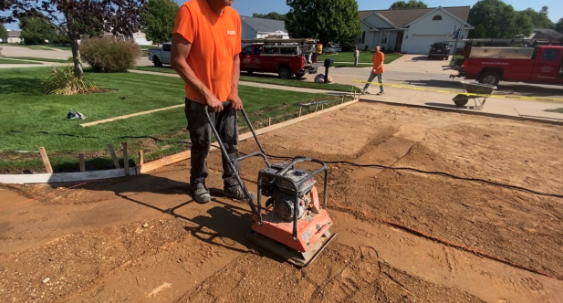
Step 4: Reinforcement Where the Driveway Needed It Most
Not every part of a driveway carries the same stress. Garage approaches, turning areas, and transition points often take more concentrated loading than other sections.
To help manage those stresses, this driveway included:
- wire mesh to help control surface cracking
- rebar in high-stress and load-bearing zones
- dowels at joints and transitions to help prevent vertical movement
This combination helped the slab act more like a unified system instead of a series of isolated panels.
Step 5: Added Protection With an Integral Sealer
To improve long-term durability, an integral sealer was added directly into the concrete mix.
That provided added protection against conditions that commonly affect driveways in Michigan, including:
- water absorption
- deicing salts
- freeze-thaw damage
- long-term surface deterioration
Because the sealer was built into the mix, it added protection without depending on repeated reapplication to do the job.
Step 6: Control Joints Planned to Manage Movement
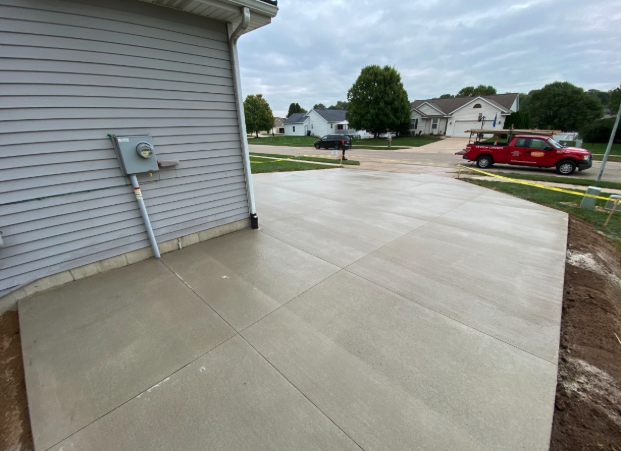
Concrete moves. The goal is not to prevent all movement. The goal is to control where that movement happens.
For this project, control joints were intentionally planned based on slab thickness, layout geometry, and likely stress points. Proper depth and timing helped make those joints effective, so normal movement could happen where intended instead of creating random cracks across the driveway surface.
The Result After 5 Years
Five years after installation, the driveway continues to perform the way it was designed to.
The 5-year review showed:
- no random or structural cracking
- no slab settlement or displacement
- joints functioning as designed
- a surface that remains intact and serviceable
That kind of outcome is not just about the concrete itself. It reflects the value of proper planning, preparation, reinforcement, moisture management, and movement control from the start.
What This Case Study Shows Homeowners
This project is a good reminder that driveway durability starts long before the concrete is poured.
A long-lasting driveway depends on:
- identifying the real cause of the old driveway’s failure
- removing unstable material
- building the right base
- compacting properly
- reinforcing the slab where needed
- planning joints intentionally
- protecting the concrete from moisture and freeze-thaw exposure
For homeowners in Michigan, these details can make a major difference in how well a driveway holds up over time.
FAQs About Driveway Replacement in Michigan
Why do some concrete driveways crack so quickly?
Driveways often crack early because of problems below the surface, such as poor base preparation, unstable soil, bad drainage, frost movement, or weak joint planning. Concrete quality matters, but the support system underneath matters just as much. This case study specifically tied the driveway’s long-term performance to planning, base prep, reinforcement, and movement control.
Does replacing a driveway mean you always need to remove the old base?
Not always, but if the existing base shows signs of contamination, settlement, or inconsistent compaction, full removal may be the better choice. In this project, removing the compromised base helped prevent existing problems from carrying into the new slab.
What helps a concrete driveway last longer in Michigan?
A driveway built for Michigan conditions should account for freeze-thaw cycles, drainage, soil movement, and seasonal loading. Important factors include a stable base, proper compaction, reinforcement, control joints, and protection against water and deicing salts.
Do control joints actually prevent driveway cracks?
Control joints do not stop concrete from moving, but they help direct where cracking occurs. When they are properly planned and installed, they reduce the chance of random cracking across the slab surface.
Is reinforcement enough to stop cracking on its own?
No. Reinforcement helps manage stress and distribute loads, but it works best as part of a larger system that includes a stable base, proper compaction, drainage planning, and joint layout. In this project, reinforcement was only one part of why the driveway has performed well over five years.
What can homeowners learn from this driveway case study?
The biggest takeaway is that long-term driveway performance depends on how the project is built from the ground up. The visible concrete surface matters, but what is underneath it often determines whether the driveway lasts.
Need a Driveway Replacement Built for Michigan Conditions?
If your driveway is cracking, settling, or showing early signs of failure, the problem may go deeper than the surface. Kent Home Services takes a long-term approach to driveway replacement by focusing on the base, drainage, reinforcement, and concrete performance details that help the finished slab last.
Contact Kent Home Services to talk about a driveway replacement designed for real Michigan conditions.